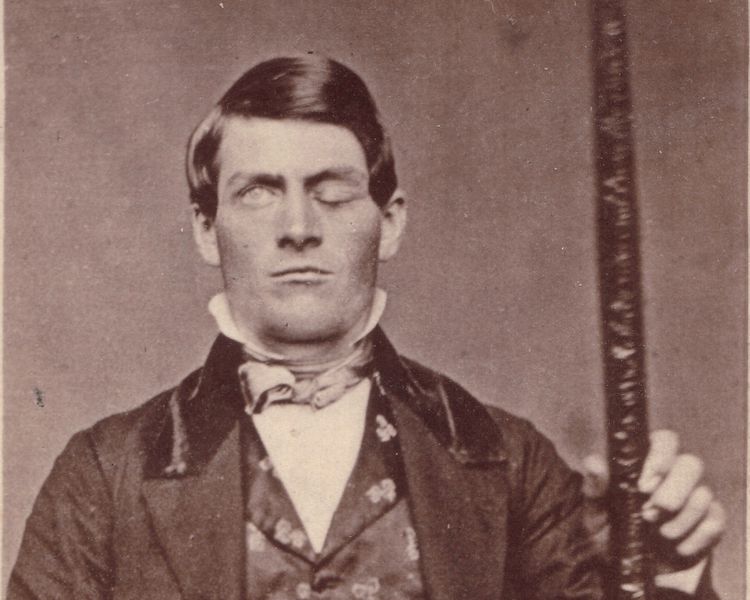
In 1848, a 25-year-old railroad worker was hit in the head by a 13-pound tamping rod that was 3 feet 7 inches long (Lapinski 2022). This rod damaged his left frontal lobe by being propelled through his head under his left cheekbone and the top of his skull. He survived by no small amount of luck. Most of us who have taken psychology or neuroscience classes have heard of his name, Phineas Gage.
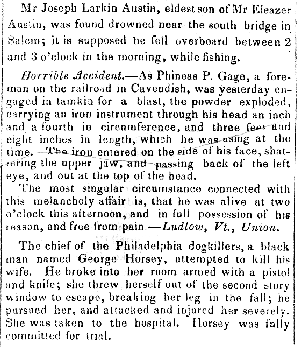
Now with our modern techonogly, we know the rod passed through the parts of his brain responsibile for emotional processing and decision making (Cherry 2024). Scans of Gage’s skull and 3D models were built to answer this question. Though, a “modern day Phineas Gage,” known as E.L., experienced a similar injury via iron rod that impacted 11% of his brain (de Freitas 2022). Through E.L., we know now that the brain can “recruit” other parts of the brain to help compensate.
After this accident, Gage’s personality changed drastically. Before he was described as “…their most capable and efficient foreman, one with a well-balanced mind, and who was looked on as a shrewd smart business man.” (Macmillan 1999). Post-accident, he was described by his friends as “No longer Gage” (Macmillan 1999). Most of the articles I read then go on to describe an really unpleasant person. The word “irritability” was used frequently and he also allegedly cursed a lot.
For a time, Gage traveled around witht he iron rod that changed his life. He used it as a means of making money. The shock and awe factor was definetly something people of the time would want to see.
Gage’s doctor, Dr. John Martyn Harlow, made many observations and was his attending physician. “Harlow noted that Gage knew how much time had passed since the accident and remembered clearly how the accident occurred, but had difficulty estimating the size and amounts of money.” (Cherry 2024). Dr. Harlow eventually came into possession of Gage’s skull after his passing from a series of epileptic seizures.
Gage died May 21, 1860 which was 12 years after the accident. His skull was donated to Harvard by Dr. Harlow.
References
Cherry, K. (2024 January 17). Phineas Gage: his accident and impact on psychology. VeryWell Mind. https://www.verywellmind.com/phineas-gage-2795244
de Freitas, P. H. M., Monteiro, R. C., Bertani, R., Perret, C. M., Rodrigues, P. C., Vicentini, J., de Morais, T. M. G., Rozental, S. F. A., Galvão, G. F., de Mattos, F., Vasconcelos, F. A., Dorio, I. S., Hayashi, C. Y., Dos Santos, J. R. L., Werneck, G. L., Tocquer, C. T. F., Capitão, C., da Cruz, L. C. H., Jr, Tulviste, J., Fiorani, M., … Rozental, R. (2022). E.L., a modern-day Phineas Gage: Revisiting frontal lobe injury. Lancet regional health. Americas, 14, 100340. https://doi.org/10.1016/j.lana.2022.100340
Hamilton, J. (2017 May 21). Why brain scientists are still obsessed with the curious case of Phineas Gage. NPR. https://www.npr.org/sections/health-shots/2017/05/21/528966102/why-brain-scientists-are-still-obsessed-with-the-curious-case-of-phineas-gage#:~:text=The%20injury%20changed%20his%20personality%2C%20and%20our%20understanding%20of%20the%20brain
Lapinski, S. (2022 August 12). The Phineas Gage Case. Harvard Countway Library. https://asklib.hms.harvard.edu/faq/153359
Macmillian, M. (1999 August 15). The Phineas Gage information page. https://www.uakron.edu/gage/index.dot
Medlink Neurology. (2023 November 17). Neurology through the history: the intriguing case of Phineas Gage. https://www.medlink.com/news/neurology-through-history-the-intriguing-case-of-phineas-gage
Teles R. V. (2020). Phineas Gage’s great legacy. Dementia & neuropsychologia, 14(4), 419–421. https://doi.org/10.1590/1980-57642020dn14-040013
 Witch Psych
Leave a comment